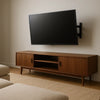
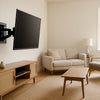
Is a Full-Motion TV Mount Worth It? A Practical Guide

The answer to this question depends entirely on your room and how you use it.
The quick answer: A full-motion TV mount is worth it when you need to adjust the viewing angle horizontally—for example, in rooms with multiple seating positions or open layouts.
It’s not worth it if:
- Your TV already faces your seating directly
- Or your main issue is height (like above a fireplace)
Full-motion mounts solve side-to-side viewing. Some can also address height—but only if they’re designed with vertical travel. Let’s dig deeper.
What a Full-Motion Mount Actually Does
A full-motion (or articulating) mount lets your TV:
- Swing side to side
- Tilt up and down
- Extend away from the wall
That flexibility is what you’re paying for—and it can be incredibly useful in the right setup.
But it also means:
- More complexity
- More wall stress
- A higher price
So the real question isn’t, “Is it better?” It’s, “Do you actually need that movement?”
When a Full-Motion Mount Is Worth It
This is where full-motion mounts really earn their keep.
Open floor plans
Watching from both the couch and the kitchen? You’ll use the swivel constantly.
Off-center seating
If your couch isn’t directly in front of the TV, being able to angle the screen makes a big difference.
Multi-use rooms
Spaces where the TV serves different viewing positions at different times.
In these cases, the flexibility isn’t just nice to have—it solves a real, everyday problem.
When It’s Not Worth It
There are situations where a full-motion mount doesn’t add much value.
Single seating position directly in front of the TV
You won’t use the movement.
Well-positioned, eye-level setups
A fixed or tilt mount does the job more simply.
Above the fireplace (with most mounts)
This is where things get misunderstood.
Why Most Full-Motion Mounts Don’t Work Well Above a Fireplace
On paper, it seems like they should help. You can pull the TV out and tilt it down—so problem solved, right?
Not quite.
The issue with above-fireplace TVs isn’t angle—it’s height.
Most setups place the screen center 60–70+ inches off the floor, well above the ideal viewing height. A standard full-motion mount can bring the TV closer to you, but it doesn’t lower it.
So you’re still looking up at the same angle, just from a slightly different position. That’s why many people install a typical full-motion mount in this scenario and still feel like something’s off.
The Key Difference: Vertical Travel
Not all full-motion mounts are the same.
Traditional articulating mounts focus on horizontal movement. They’re not designed to bring the TV down to a comfortable viewing height.
But some full-motion mounts are built differently.
For example, mounts like the MantelMount MAX1 combine full-motion flexibility with vertical travel, allowing you to lower the TV when in use and return it to its original position when you’re done.
That added range of motion is what makes the difference above a fireplace. Without it, you’re only adjusting angle, not solving the core problem.
The Physics Most People Don’t Think About
There’s also a structural side to this decision.
When a full-motion arm extends, it acts like a lever. That means the force on your wall isn’t just the weight of the TV—it’s amplified.
For example, a 55-lb. TV extended 20 inches creates significantly more force at the mounting points than when it’s flush. That makes proper installation critical, and stud mounting is non-negotiable.
It also means lower-quality mounts can become a problem over time. It’s not a dealbreaker, but it’s something to factor in.
What About Cable Management?
With a fixed mount, cables stay put. With a full-motion mount, they move every time you reposition the TV.
That means:
- You need extra slack (usually 12–18 inches)
- Cables are harder to hide cleanly
- Poor routing can lead to wear or disconnection
It’s manageable, but it’s not as “set it and forget it” as a fixed setup.
Which Type of TV Mount Works Above a Fireplace?
If your TV is mounted high, the real solution is changing the viewing height—not just the angle.
You have two options:
1. A mount with vertical travel
Some full-motion mounts are engineered to lower the TV to eye level and raise it back up when not in use. This combines flexibility with proper ergonomics.
2. A dedicated pull-down mount
These are specifically designed for above-fireplace setups and focus entirely on vertical movement.
Both approaches solve the same core issue. The key is making sure the mount you choose actually addresses height—not just angle.
Simple Decision Guide
If you’re trying to decide quickly, use this:
- TV directly in front of one seating area: Fixed or tilt
- TV viewed from multiple angles: Full-motion
- TV above a fireplace: Full-motion with vertical travel or a pull-down mount
Final Takeaway
A full-motion mount is a great solution when it’s solving the right problem.
If you need flexibility across multiple viewing positions, it’s worth it. If your setup is already aligned, it’s unnecessary.
And if your TV is above a fireplace, the question isn’t whether you need full motion—it’s whether your mount can actually bring the TV down to a comfortable height.
Start with your room, not the product. Once you do that, the right choice becomes clearer.
Frequently Asked Questions
Does mounting a TV above a fireplace cause neck strain?
Yes — mounting a TV above a fireplace typically positions the screen center at 60–72 inches from the floor, which is 15–30 inches above the ergonomically correct eye-level viewing height of 42–48 inches for a seated adult. Watching a TV at this height requires sustained upward neck extension, which creates measurable neck and shoulder strain over a standard 2-hour viewing session. Modern flat-panel TVs also deliver degraded picture quality — reduced color accuracy and contrast — when viewed at steep upward angles, compounding the discomfort. A pull-down TV mount like MantelMount solves this by lowering the TV to eye level for viewing and raising it back flush when not in use, eliminating both the ergonomic and picture-quality problems without changing where the TV is mounted.
When does a pull-down TV mount make more sense than a full motion mount?
A pull-down TV mount makes more sense than a full motion mount whenever the TV is mounted above a fireplace or at any height significantly above seated eye level. Full motion mounts extend the TV outward from the wall and allow horizontal swivel — they do not lower the TV vertically. Because the above-fireplace height problem is vertical, a full motion mount cannot solve it regardless of how far it extends. A pull-down mount, by contrast, is engineered specifically to bring the TV down to eye level for viewing and return it to its resting position when not in use. For any other wall placement — where the TV is already near eye level and the room has multiple seating angles — a full motion mount remains the more appropriate choice.
Can a full motion TV mount be installed on drywall without studs?
No — a full motion TV mount should not be installed on drywall without stud anchoring. The articulating arm of a full motion mount creates significant torque on the wall anchor points when extended, multiplying the TV's effective weight through leverage. Standard US residential drywall (1/2-inch or 5/8-inch) and drywall anchors, including toggle bolts, cannot reliably bear this dynamic load for TVs larger than 40 inches. Both mounting points must be anchored into wall studs at standard 16-inch spacing. If your wall's stud layout does not align with the mount's bolt pattern, a structural mounting plate that bridges two studs is required before installation. Improper anchoring is the most common cause of full motion mount failure and wall damage.
TECHNICAL SEO
Schema & Metadata
Leave a comment
Please note, comments must be approved before they are published.