Open Floor Plan TV Mounting: What Actually Works in Open Concept Rooms

Most TV mounts are built for a single room with a single seating position. Open concept spaces break that model completely. So how and where should you mount your TV? Good question.
Let’s walk through it.
First, Rule Out What Doesn’t Work
A fixed mount might seem like the cleanest option—but in an open floor plan, it rarely holds up.
If your room has more than one viewing zone, a fixed mount gives you a great picture in exactly one spot. Everywhere else gets an off-angle view with reduced contrast and color.
The Mount Types That Actually Make Sense
Once you eliminate fixed mounts, you’re left with three real options—and one that most guides don’t talk about enough.
Articulating mounts (basic swivel)
These extend slightly and allow some side-to-side movement.
- Good for smaller rooms
- Works when seating is within ~45° of each other
But if your kitchen island is sitting perpendicular to your sofa, this won’t be enough.
Full-motion mounts
This is where things start to work better.
- Wider swivel range
- More extension
- Handles multi-zone layouts
If your seating areas span 60–90° or more, this is the category you need.
Pull-down mounts
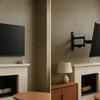
Pull-down mounts don’t just swivel or tilt—they change height. They bring the TV down from a higher position (like above a fireplace) to eye level when you’re watching.
That solves a completely different problem.
When You Need More Than Just Swivel
In a typical open floor plan, your viewing setup might look like this:
- Sofa → centered, 12–15 feet away
- Kitchen island → 60–90° off to the side
- Dining table → somewhere in between
Each one needs a different screen angle to look right.
Here’s a simple way to figure out what you need:
- Stand where your TV will go
- Look at each seating area
- Measure the angle between them
Then add about 15° of buffer.
If your seating zones are 75° apart, you’ll want a mount that can handle ~90° of rotation comfortably.
That’s why full-motion (or swivel) capability is so important in these rooms.
The Fireplace Dilemma
In most open concept spaces, the fireplace becomes the default TV wall.
It makes sense visually—but it creates two problems at once:
- The TV is too high
- The viewing angles are off for multiple seating areas
A typical above-fireplace setup puts the screen center around 80–90 inches from the floor. That’s far above the ideal eye-level range of 42–48 inches.
So:
- Couch viewers are looking up
- Island viewers are looking up and sideways
That combination affects both comfort and picture quality.
And here’s the key point: These aren’t separate issues—they’re the same problem from different angles.
What Actually Fixes It
This is where mount choice really matters.
A full-motion mount can help with horizontal viewing—but it won’t fix height.
A pull-down TV mount does.
By lowering the TV to eye level when you’re watching, it:
- Eliminates neck strain
- Improves picture quality
- Improves sightlines across all seating areas
If your TV is above a fireplace, changing the vertical position is what makes the biggest difference.
Planning Your Setup
This is where most people skip ahead—and regret it later. A few things to get right first:
Choose the right wall
- Fireplace wall works—but only with the right mount
- Otherwise, look for a wall that minimizes glare and maximizes viewing angles
Match TV size to the space
Open rooms are big. A small TV will feel even smaller.
- 65” → ~8 ft minimum
- 75” → ~9.5 ft
- 85” → ~11 ft
If your kitchen is 20 feet away, sizing up makes a difference.
Check traffic flow
Full-motion mounts extend into the room. Make sure that extension doesn’t interfere with walkways.
Plan cable routing early
Once cables are in the wall, moving them isn’t simple. Finalize placement first.
Getting the Height Right
For standard seating:
- TV center should sit around 42–48 inches from the floor
But open layouts often have two viewing heights:
- Sofa → ~42–48 inches
- Bar-height seating → ~52–56 inches
No fixed mount satisfies both.
- A swivel mount helps horizontally
- A pull-down mount helps vertically
If your stored TV height is above ~60 inches, a standard mount won’t feel right long-term.
Managing Glare in Open Spaces
Open floor plans naturally bring in more light—windows, glass doors, skylights. That means more glare. One of the most effective fixes isn’t what most people expect:
Adjust the angle of the screen. Even a 10–15° rotation can eliminate reflections from a window or skylight because it changes how light hits the screen.
That’s something window treatments alone can’t do. Of course, combining both works best:
- Use shades or blinds where needed
- Adjust the screen angle when lighting changes
Don’t Overlook Cable Planning
This is one of the biggest miss points. If your mount moves, your cables need to move with it.
- Swivel mounts → add 18–24 inches of slack
- Pull-down mounts → add 24–30 inches
The cleanest setup:
- Run cables through in-wall conduit
- Leave a loop behind the TV to handle movement
Without that slack, cables will pull or limit how far your mount can actually move.
Quick Layout Checklist
Before choosing a mount, make sure you’ve:
- Identified all seating zones
- Measured angles between them
- Checked viewing distances
- Noted window and glare sources
- Measured mantel height (if applicable)
- Planned cable routing
- Verified stud locations
These decisions determine everything that comes after.
Super-Quick Guide
It comes down to your setup:
- No fireplace + multiple viewing angles → Full-motion mount
- Above fireplace + single seating area → Pull-down mount
- Above fireplace + multiple seating zones → Pull-down with swivel
Which MantelMount Is Right for Your Open Concept Room?
If you've worked through the checklist and the sightline geometry, the model selection is straightforward.
MM815 — Motorized Swivel Pull-Down: The right choice for open concept great rooms with above-fireplace placement and multiple seating zones spanning more than 60 degrees. Motorized swivel means the screen rotates toward any zone — sofa, island, dining table — without manual repositioning. The pull-down mechanism lowers the TV from above-fireplace height to eye level. If your room has a fireplace and more than one seating zone, this is the purpose-built answer.
MM-MAX1 Full Motion TV Mount: Another excellent choice for open concept rooms is the Max1. Designed for true home entertainment connoisseurs, MAX1 not only matches the motion capabilities of traditional full motion mounts, but adds a significant 29 inches of pull-down vertical travel to the equation, making it the first-of-its kind in the full-range motion TV mount category.
MM700 — Premier Pull-Down, Non-Motorized: The right choice for above-fireplace placement in rooms where seating zones are within 45 degrees of each other and manual swivel adjustment is acceptable. Premier build quality and smooth pull-down operation make it the best non-motorized option for design-conscious homeowners.
MM540 — Enhanced Pull-Down: The right choice for above-fireplace placement with a single primary seating zone or where the MM700's feature set exceeds the room's requirements. Delivers the core pull-down mechanism with enhanced features over the entry-level model.
MM340 — Entry-Level Pull-Down: The right choice for above-fireplace placement in smaller rooms or secondary screens. The core pull-down mechanism at the accessible end of the MantelMount range.
Frequently Asked Questions
How high should a TV be mounted in an open concept room?
In an open concept room, the center of the TV screen should be at seated eye level — approximately 42 to 48 inches from the floor for standard sofa seating. When the TV is mounted above a fireplace, the mantel typically places the screen center at 80 to 90 inches or higher, which is well above the ergonomic ideal and causes neck strain over time. MantelMount's pull-down mechanism solves this by lowering the TV 20 or more inches from its stored position to eye level for viewing, then raising it back flush when not in use — making above-fireplace placement ergonomically viable for the first time.
What is the best TV mount for multiple seating zones in an open floor plan?
The best TV mount for a room with multiple seating zones — such as a sofa, kitchen island, and dining area — is one that combines wide swivel range with the ability to lower the TV to eye level if it is mounted above a fireplace. For open concept great rooms with above-fireplace placement and seating zones spanning more than 60 degrees, the MantelMount MM815 is the purpose-built solution: its motorized swivel rotates the screen toward any seating zone without manual repositioning, and its pull-down mechanism lowers the TV from above-fireplace height to eye level for comfortable viewing from every seat in the room.
How do you avoid TV glare in an open floor plan?
Avoiding TV glare in an open floor plan requires both a glare audit and a mount that can reposition the screen. Start by identifying your primary glare sources — large windows, sliding glass doors, and skylights are the most common in open concept great rooms — and note the direction of light at the time of day when glare is worst. A swivel or pull-down TV mount is a direct glare mitigation tool: rotating the screen 10 to 15 degrees can move a glare source off the reflective surface entirely, and lowering a TV from above-fireplace height changes its vertical angle relative to overhead skylights. Window treatments such as solar shades are a useful complement, but mount adjustability is the most effective first step. For additional glare management strategies, see our guide on [how to reduce TV glare](/reduce-glare).
TECHNICAL SEO
Schema & Metadata
Leave a comment
Please note, comments must be approved before they are published.