Best TV Mount: How to Choose Between Fixed, Tilt, Full-Motion, and Pull-Down

Choosing a TV mount seems simple—until you live with the wrong one.
Not quite the right angle. Neck strain. Can’t quite get comfortable. There’s that glare again. But the setup looked perfect on paper!
That’s because mounting your TV is not a one-size-fits-all proposition. The right mount depends entirely on your room, your wall, and how you actually watch TV. This guide walks through those constraints first, so you can eliminate the wrong options quickly and land on the right one.
TV Mount Types: What They’re Actually Good For
Not all mounts solve the same problem. Each one works in a specific scenario.
Fixed mounts
These hold your TV flat against the wall with no movement. They’re ideal when your TV is already at eye level and you have a single seating position. It’s clean, low-profile, and affordable, but completely unforgiving if the placement isn’t perfect.
Tilt mounts
Tilt mounts angle the screen downward slightly. They help reduce glare when the TV is mounted just above eye level. What they don’t do is change height. If your TV is too high, a tilt mount won’t fix it.
Full-motion mounts
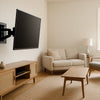
These extend, swivel, and tilt. They’re best for open floor plans or rooms with multiple viewing angles. The tradeoff is added bulk and more stress on the wall, which means proper stud mounting is critical.
Pull-down mounts
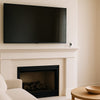
This is the category most guides skip—but it’s the only real solution for TVs above fireplaces. These mounts allow you to lower the TV to eye level when watching, then return it to a higher position when not in use. They’re purpose-built for one specific problem—and they solve it.
How to Choose the Right Mount (Quick Decision Guide)
Start with your setup, not the product:
-
Above a fireplace?
→ You need a pull-down mount. No exceptions. -
Multiple seating areas or open layout?
→ Full-motion mount. -
Single viewing angle at eye level?
→ Fixed mount. -
Mounted slightly high on a standard wall?
→ Tilt mount. -
Mounting in a corner?
→ Full-motion mount designed for corner use.
Once you know your category, everything else becomes easier.
>> Check out MantelMount’s collection of pull-down, full-motion TV mounts.
Compatibility Check: Do This Before You Buy
Two things matter more than anything else: VESA pattern and weight rating.
VESA pattern
This is the spacing of the mounting holes on the back of your TV. It’s measured in millimeters (for example, 400×400). Your mount must match this exactly.
Weight rating
This isn’t flexible. If your TV weighs more than the mount is rated for, it’s not a close call—it’s a failure risk.
For installation:
- TVs over ~50 lbs should be mounted into studs using lag bolts
- Drywall anchors alone are not enough for large TVs
- Larger TVs (75”+) often require heavier-duty mounting and more careful installation
Take two minutes to confirm these before you shop.
Mounting Above a Fireplace: What Most People Get Wrong
This is where most setups fail.
The ideal viewing height places the center of your TV at about 42–48 inches from the floor. Above a fireplace, it’s usually 65–75 inches.
That difference forces you to look up at the screen—often at a 15–30° angle. It might feel fine at first, but over time it leads to real discomfort.
It also affects picture quality. Most TVs lose contrast and color accuracy when viewed from below.
Why tilt mounts don’t fix this
They angle the screen—but don’t lower it. Your neck is still tilted upward.
Why full-motion mounts don’t fix it
They can extend outward, but they’re not designed to safely drop a TV down to eye level.
What actually works
A pull-down mount.
It allows the TV to sit above the fireplace when not in use, then lower to a comfortable viewing height when you’re watching. It’s the only option that solves both the design and comfort problem at the same time.
Mounting on Plaster and Other Difficult Walls
Older homes add another layer of complexity. Plaster walls are thicker and more brittle than drywall, which makes both stud-finding and drilling more difficult.
Key considerations:
- Finding studs is harder. Standard stud finders can struggle. A deep-scan tool or careful manual probing works better.
- Use the right hardware. Lag bolts into studs are always preferred. For non-stud areas, heavy-duty toggle anchors can work—but only for lighter TVs.
- Drill carefully. Plaster can crack easily. Start slow and use the right bit.
Other tricky surfaces:
- Paneling or shiplap. Mount into studs behind it
- Brick or concrete. Use masonry anchors rated for the load
If you’re unsure about the structure or working with an especially large TV, this is where professional installation makes sense.
DIY vs. Professional Installation
A standard install on drywall is manageable for most people with basic tools:
- Stud finder
- Drill
- Level
- Socket wrench
The bigger challenge is often cable management.
- In-wall routing gives the cleanest look but takes more effort
- Surface raceways are easier and still look clean when painted
- Moving mounts (like pull-down or full-motion) require extra attention so cables don’t snag
When to bring in a professional:
- You can’t confidently locate studs
- The TV is large or heavy
- You’re mounting above a fireplace
- You’re drilling into masonry
It’s less about skill and more about risk.
What to Avoid When Buying a Mount
There’s a lot of low-quality hardware out there. Watch for these red flags:
- Unclear weight ratings. If there’s no testing or certification, don’t trust it.
- “Universal fit” without specifics. Always verify VESA compatibility.
- Weak or flexible materials. If it feels flimsy before installation, it won’t improve under load.
- Poor or incomplete hardware. Mounts should include proper lag bolts—not just basic screws.
- Cheap components in moving mounts. The internal mechanism matters. Low-quality parts wear out quickly.
This is one area where cutting corners usually shows up later.
The Best TV Mount Isn’t About Features – It’s About Fit
Consider your wall type, viewing position, and how you actually use the space. Get this decision right, and you’ll never have to think about your TV setup again.
>> Review side-by-side features and specs on MantelMount’s pull-down mounts.
Frequently Asked Questions
What type of TV mount do I need for above the fireplace?
A pull-down TV mount is the only type engineered specifically for above-fireplace placement. Fixed, tilt, and full-motion mounts all leave the TV at a static height that forces viewers to crane their necks upward — typically 15 to 30 degrees above the ergonomically correct eye-level viewing position. A pull-down mount like MantelMount uses counterbalance technology and automotive-grade gas pistons to lower the TV to eye level for viewing and raise it flush against the wall when not in use, resolving both the aesthetic and ergonomic conflict of above-fireplace TV placement.
Can you mount a TV on plaster walls?
Yes, you can mount a TV on plaster walls, but it requires a different approach than standard drywall installation. The primary challenge is locating studs, since standard stud finders often fail on plaster due to wall thickness and wood lath interference — a deep-scan stud finder or the knock-and-probe method is more reliable. For stud-mounted installs, use lag screws long enough to penetrate the plaster layer (typically 5/8 to 7/8 inch) and bite at least 1.5 inches into the stud. For non-stud locations, use load-rated toggle bolt anchors such as Toggler SnapToggles, and do not exceed 50 lbs on toggle bolt anchors in plaster. If studs cannot be confidently located or the TV exceeds 85 lbs, professional installation is the appropriate choice.
How high should a TV be mounted above a fireplace?
The ergonomically correct viewing height places the center of the TV screen at approximately 42 to 48 inches from the floor — roughly eye level when seated. Most fireplace mantels sit 48 to 60 inches from the floor, which means a TV mounted above the mantel typically has its screen center at 65 to 75 inches — 20 to 30 inches above the recommended viewing height. This height discrepancy is the core problem with standard above-fireplace TV mounting, and it cannot be corrected by a tilt mount. A pull-down TV mount resolves this by allowing the TV to be lowered to eye level for viewing and raised back to its stored position above the fireplace when not in use.
TECHNICAL SEO
Schema & Metadata
Leave a comment
Please note, comments must be approved before they are published.