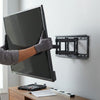
When a TV Falls Off the Wall: Why It Happens and How to Prevent It

What surprises homeowners most is this: TVs rarely fall because the mount was cheap. They fall because the system was wrong. Wall type, stud engagement, fasteners, mount style, and daily use combine into a setup that either stays solid for years or slowly loosens until gravity wins.
This guide explains why TV mounts fail, what “safe” actually means, and how to prevent a TV from falling in ways that hold up beyond day one.
If Your Mount Is Failing Right Now, Do This First
If the TV is sagging, shifting, or cracking the wall, treat it as an active failure.
Stop using the mount immediately if you see:
the TV tilting forward
the wall plate separating from the wall
cracking drywall that worsens with movement
bolts backing out
Take the TV down with a friend. Unplug power before handling bent plugs or damaged cords. Do not tighten the mount and hope for the best. Tightening into damaged material often speeds up the next failure.
Why TVs Fall Off Walls
A is simple in concept but unforgiving in physics. Weight is only part of the equation. The farther the TV sits from the wall, the more leverage it creates on the fasteners. That leverage pries bolts outward, crushes drywall, or splits a stud at its weakest point.
Most failures follow the same patterns: the mount wasn’t anchored to structure, the wrong fastener was used, the mount type created more leverage than the wall could handle, or a small installation error worsened over time.
In real homes, it’s usually a chain reaction. A stud was missed slightly. A lag bolt felt tight because it compressed drywall instead of biting wood. A full-motion arm was pulled forward daily. Eventually the holes enlarged, the bolts loosened, and the mount failed.
Read More: How to Repair Drywall After Removing a TV Mount
The Drywall Myth
Drywall is a finishing surface, not structure. It can hold light, static loads, but a TV mount isn’t static. TVs are bumped, swiveled, re-cabled, and adjusted. Every movement adds stress.
That’s why mounts pulling out of drywall are so common. Once drywall is crushed or fractured around a fastener, re-tightening doesn’t restore strength. It enlarges the hole and accelerates failure. The mount may feel solid briefly, then loosen faster than before.
If your TV relies on drywall strength to stay on the wall, it’s on borrowed time. Drywall also behaves inconsistently depending on age, moisture, patching, and framing gaps, which makes drywall-only mounting unpredictable.
Missed Studs and Edge Bites
The most common hidden cause of TV mount failures is thinking a stud was hit when it wasn’t.
A lag screw can catch the edge of a stud and feel tight as drywall compresses. But that isn’t clamping. It’s carving. Over time, the screw chews through edge fibers, the bite loosens, and the mount shifts.
Stud spacing assumptions add risk. Not all homes use 16-inch spacing. Some are 24 inches. Others are irregular around fireplaces or remodels. When a heavy object hangs over people, “close enough” engagement isn’t safe.
Mount Type Matters
A fixed mount that holds the TV close to the wall is forgiving. A tilting mount adds modest leverage. A full-motion mount multiplies forces dramatically.
This is where weight ratings mislead. A mount rated for 100 pounds assumes correct anchoring into appropriate structure. When a full-motion arm extends, the TV’s center of mass moves outward and leverage spikes.
If you don’t truly need motion, a fixed or low-profile tilt mount is usually the safest long-term choice. If you do need motion, anchoring has to be treated like a structural project, not a convenience install.
Visit the MantelMount collection of TV mounts
Common Hardware Mistakes
When people say a mount “broke the wall,” it’s usually one of a few issues.
Lag bolts that are too short, too thin, or over-torqued may feel tight but fail later.
Anchor ratings often assume ideal conditions and static loads that don’t reflect real walls or real use. Some anchors also creep over time.
Another common issue is brackets that aren’t fully seated or locked. Many mounts rely on hooks and locking screws. If the TV isn’t fully engaged, a small upward jolt can unhook it even if the wall looks undamaged.
Wall Types That Change the Rules
Not all walls are wood studs behind drywall. Metal studs are possible but less forgiving. Masonry or concrete can be excellent when anchored correctly, but failures often come from weak mortar or edge drilling. Old plaster or lath walls are unpredictable, and powdery dust or blowout holes signal the need for reinforcement.
A Crooked TV Is a Warning
A crooked TV isn’t always a cosmetic problem. It can signal uneven stud engagement, uneven compression, or mount movement under load. If the tilt worsens over time, don’t just re-level and move on. Drift is often the early stage of failure, especially with full-motion mounts.
How to Prevent a TV From Falling
The shortest path to fewer regrets is simple. that matches how you actually use the TV. Anchor into real structure, not cosmetic layers. Ignore how tight a bolt feels without proper engagement. Respect leverage, especially at full extension.
Quick fixes usually backfire, so take your time.
When to Bring in Help
Consider professional help if:
the wall construction is unknown, metal-stud, or plaster
the TV is large and the mount is full-motion
the mount already failed
you can’t confidently verify stud engagement
A safe install costs less than replacing a TV, repairing a wall, or dealing with a preventable injury.
A Simple Checklist
Before hanging the TV, confirm:
the mount matches the TV’s VESA pattern and weight
the wall plate is anchored into structure
fasteners aren’t reused in damaged holes
leverage is accounted for
the TV is fully seated and locked
Check out the collection of pull-down TV mounts to find the one that’s right for you.
Leave a comment
Please note, comments must be approved before they are published.